
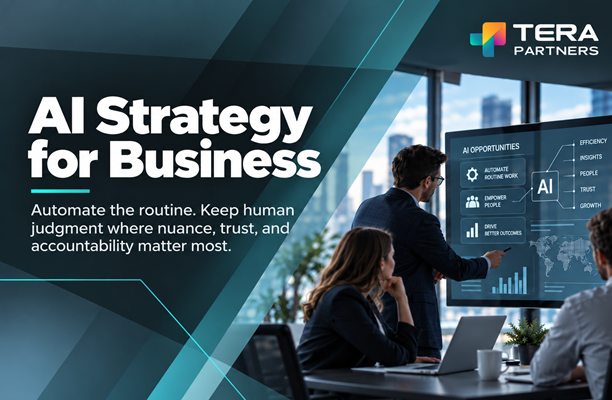
The easiest AI question for a business to ask is: What can we automate?
It may also be the wrong place to start.
As artificial intelligence becomes more capable, businesses will use it for research, analysis, writing, coding, customer support, document processing, reporting, monitoring, and increasingly, portions of decision-making itself. The immediate economic logic is compelling. If work that once required three hours can be completed in fifteen minutes, continuing to perform it manually becomes difficult to justify.
But that creates a second question with much larger consequences: What happens when the work we eliminate was also how people learned to think?
That question changes AI strategy for business from a technology decision into an organizational design problem.
The More Reliable AI Becomes, the Less Obvious Its Risk May Become
An AI system that is frequently wrong is relatively easy to manage. People distrust it, check its work, maintain alternative ways of reaching an answer, and notice inconsistencies.
Paradoxically, a system that is almost always correct creates a more difficult problem.
Imagine an AI system producing a correct result 99 times out of 100. At first, an experienced employee reviews every result. Eventually, reviewing 100 outputs to discover one error becomes expensive. The organization begins sampling instead. Later, perhaps only high-risk cases receive close review.
That progression is economically rational, but it also creates a dependency. The better the system performs, the weaker the business case becomes for independently reproducing the reasoning behind its answers.
Eventually, an organization can arrive at an uncomfortable position: the AI is reliable enough that routinely checking it is inefficient, while the organization has become dependent enough that recognizing its exceptional failures is increasingly difficult.
This is not merely theoretical. Research involving 319 knowledge workers found that higher confidence in generative AI was associated with less critical-thinking effort. The same research also suggests that AI does not necessarily eliminate critical thinking; rather, it can shift human work toward verification, integration, and oversight.
That distinction matters because the future employee may perform less of the original work while becoming increasingly responsible for determining whether machine-produced work can be trusted.
Automation Can Remove Work Without Removing Responsibility
Consider a familiar business process. An employee receives information, researches the issue, compares alternatives, applies experience, reaches a conclusion, and recommends an action.
AI may eventually become extremely good at gathering the information, researching the issue, comparing the alternatives, applying established knowledge, and producing the analysis. The employee is then left with a different responsibility: deciding whether that analysis should be trusted and what should be done with it.
It is tempting to view this simply as an efficiency gain. But the employee who previously produced the analysis is now expected to judge the analysis, and those jobs are not equivalent.
Producing an answer forces exposure to the underlying evidence. A person who spends two hours researching a problem encounters contradictions, weak evidence, unusual cases, and missing information along the way. Those details help form judgment. Someone receiving a polished two-page AI summary encounters the conclusion first and may never encounter much of the uncertainty that produced it.
Efficiency has increased, but exposure to the underlying problem has decreased. That tradeoff should be deliberate rather than accidental.
Businesses Need to Identify Their Cognitive Infrastructure
Companies already understand the concept of technical infrastructure. Servers, networks, identity systems, backups, cybersecurity controls, and business applications cannot simply disappear because employees rarely think about them.
There is another form of infrastructure that receives far less attention: institutional judgment.
It lives inside people. It is the experienced project manager who notices that a perfectly reasonable schedule cannot work because two departments behave differently in practice. It is the IT professional who recognizes that a recurring technical problem is actually the symptom of a badly designed workflow. It is the accountant who sees that a number is mathematically correct but operationally implausible. It is the executive who realizes that the question being analyzed is not the problem the business actually needs to solve.
These capabilities are difficult to document because they are partly produced through repeated exposure to real problems. AI can make those employees dramatically more productive, but an AI implementation strategy should distinguish between removing unnecessary cognitive labor and removing the experiences through which valuable judgment develops.
Those are not the same thing.
What Happens to the Apprenticeship Ladder?
This becomes particularly important for junior employees because many professions have historically developed expertise through work that senior professionals eventually stop performing.
A junior analyst gathers information. A new developer debugs relatively ordinary code. An IT technician handles repetitive support problems. A young attorney reviews documents and researches cases. Much of that work is exactly where AI can produce immediate efficiency.
But if AI performs the beginner’s work, where does the next generation of experts acquire the pattern recognition required for expert judgment?
Organizations may eventually discover that they successfully automated the bottom of a professional ladder without designing another way for people to reach the top. The answer is not to preserve inefficient work simply for tradition’s sake. It is to recognize expertise development as something that must now be intentionally designed.
AI may eliminate parts of the old apprenticeship model. It does not eliminate the need for apprenticeship.
Human Oversight of AI Is Not a Checkbox
“Human in the loop” has become a common answer to AI risk. The phrase sounds reassuring: a human reviews the AI’s work before anything important happens.
But the quality of that control depends entirely on the human.
Imagine an AI system produces 1,000 recommendations and is correct 998 times. An employee reviews them every day. After months of overwhelmingly correct recommendations, review can gradually become confirmation. The employee still clicks Approve, so the organization technically retains human oversight, but it may no longer have meaningful human scrutiny.
Effective AI governance for businesses therefore cannot be measured simply by whether a person remains somewhere in the workflow. A better question is whether that person still possesses the information, authority, expertise, and practical ability required to disagree with the system.
If not, the human may be part of the process without functioning as a genuine control.
Not All Cognitive Work Should Be Treated the Same
A useful AI strategy begins by distinguishing among different kinds of work rather than treating every task as another automation candidate.
Cognitive labor consumes human time but contributes relatively little unique judgment. Formatting, transcription, routine summarization, repetitive research, standard data entry, basic comparisons, and predictable administrative processing often fall into this category and can be strong candidates for automation.
Cognitive development is different. This is work through which employees acquire knowledge, context, pattern recognition, and judgment. Some of it may look inefficient precisely because learning itself is inefficient. Before eliminating it, organizations should understand what capability employees were developing by doing it.
Finally, there is cognitive authority: defining the actual problem, challenging assumptions, determining acceptable risk, resolving ambiguity, and deciding when an apparently correct answer should not be trusted.
AI can participate in all three categories. That does not mean all three should be automated to the same degree.
AI Should Reduce the Cost of Thinking, Not the Amount of Judgment
The strongest AI implementations may ultimately look less like employee replacement and more like organizational leverage.
AI can investigate ten hypotheses while a human might previously have had time to investigate two. It can analyze thousands of documents before an experienced professional determines which anomalies matter. It can continuously monitor systems that humans previously inspected periodically, or deliberately produce competing interpretations so decision-makers can test their initial assumptions.
Used this way, AI does more than provide answers faster. It expands the amount of evidence a human can bring into a decision.
That is fundamentally different from automating as many tasks as possible. The objective becomes automating cognitive effort where possible while preserving cognitive authority where necessary.
When Knowledge Becomes Cheap, Judgment Becomes More Valuable
For decades, organizations competed partly through access to specialized knowledge. AI is reducing the scarcity of that knowledge. Technical explanations, market research, programming assistance, financial models, contract analysis, troubleshooting guidance, and strategic frameworks can increasingly be produced on demand.
As knowledge becomes abundant, possessing information becomes less differentiating. Knowing which information matters becomes more important, as does recognizing when the available information is answering the wrong question.
That changes the characteristics of a valuable employee. The person who can produce a 30-page analysis may become less valuable than before. The person who can examine that analysis and recognize that every conclusion may be technically correct while the underlying problem has been defined incorrectly may become considerably more valuable.
This is one of the central paradoxes of AI: as machines become better at producing answers, the human ability to formulate, challenge, and occasionally reject those answers becomes more important.
A Practical Test Before Automating a Business Process
A practical AI risk management framework does not have to begin with a lengthy policy. Before handing a meaningful workflow to AI, leadership should be able to answer five questions:
- What problem are we actually trying to solve?
Define the business outcome before choosing the technology. - What human effort can disappear without weakening the organization?
Identify repetitive cognitive labor that does not need to remain human. - What expertise is currently developed by doing this work?
Determine whether automation removes an informal training mechanism. - How will we recognize the AI’s exceptional failures?
“A person will review it” is insufficient unless that person remains capable of independently challenging the result. - Who retains decision authority?
Someone must remain responsible not merely for approving the answer, but for questioning the assumptions that produced it.
These questions turn AI governance from a policy document into an operating model.
The Objective Is Not Maximum Automation
Businesses are entering a period in which declining to automate some work may increasingly require justification. That is probably healthy; organizations should not preserve repetitive work merely because it is familiar.
But maximum automation is not the same thing as maximum capability.
A company can become extremely efficient while quietly becoming less capable of understanding its own decisions. That is the boundary AI strategy must learn to manage.
The organizations that benefit most from AI may not be those that automate the greatest percentage of their work. They may be the ones that understand something more fundamental:
AI should replace unnecessary effort before it replaces necessary judgment.
The long-term risk is not simply that artificial intelligence will sometimes be wrong. It is that artificial intelligence may become reliable enough that independently thinking through its answers begins to look inefficient.
And once serious reasoning appears economically irrational, preserving the ability to reason becomes a strategic decision of its own.
Tera Partners helps businesses evaluate technology in the context of their actual operations—identifying opportunities to improve efficiency, strengthen workflows, reduce unnecessary complexity, and introduce AI where it creates practical business value without sacrificing appropriate oversight.
If your organization is considering AI, automation, or broader changes to its technology environment, contact Tera Partners to discuss where the right opportunities may exist—and where keeping a human in control still matters.