
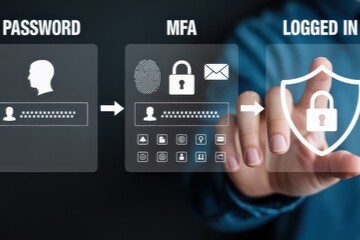
Multifactor authentication fatigue happens when repeated login prompts wear down a user until one is accepted simply to make the interruption stop.
That is what makes the issue so uncomfortable for businesses. Multifactor authentication, often shortened to MFA, is still one of the most effective baseline protections because it requires a second form of verification beyond the password. The weakness appears when the experience around that control becomes easy to exploit. The U.S. Cybersecurity and Infrastructure Security Agency, or CISA, describes MFA as a major protection against unauthorized access, but it has also documented attacks that rely on repeated approval prompts until user presses accept.
In practice, this is less about technology failure than about pressure, confusion, and timing. A user sees one prompt, then another, then another. The request may appear during a busy moment. The login attempt may seem vaguely plausible. Eventually, the security step that was supposed to confirm intent starts functioning more like an interruption the user wants to clear.
Why Multifactor Authentication Fatigue Matters More Than It First Appears
The business risk in multifactor authentication fatigue is not just that a user might click the wrong button once.
The larger problem is that it exposes a gap between having a security control and having a security control that remains strong under real-world conditions. If the business relies heavily on push approvals alone, and users are trained more to get through prompts than to question them, the environment may be less protected than leadership assumes.
That is why this topic matters beyond identity security teams. It affects access, remote work, cloud platforms, email accounts, administrator roles, and vendor-connected systems. If a single approval can validate a malicious sign-in, the result may be broader than one compromised account.
An MFA Fatigue Attack Uses Pressure More Than Sophistication
An MFA fatigue attack often succeeds not because it is technically impressive, but because it is timed well enough to exploit routine behavior.
CISA has publicly described cases where attackers sent repeated MFA prompts until employees accepted one, a tactic commonly referred to as MFA fatigue. In some cases, attackers also contacted users directly to make the request seem legitimate.
That is what makes the tactic useful to attackers. It does not depend entirely on bypassing the control. It depends on getting the user to approve access for them.
From an operational standpoint, that is a different kind of risk. It means the business cannot treat MFA as complete protection if users are still being asked to approve requests they did not initiate and the environment has no stronger method for distinguishing real access from manipulated access.
MFA Push Notifications Are Useful, but They Need More Structure
Many organizations rely on MFA push notifications because they are fast and familiar.
That convenience is real, but convenience alone is not enough. When push approvals become too routine, users can start responding to them reflexively rather than intentionally. The result is a control that still exists on paper, but is easier to misuse in practice.
This is where implementation matters. A stronger model may include tighter sign-in review, better user education, and methods that reduce blind approval behavior rather than depending on it. CISA’s MFA guidance continues to recommend strong MFA use, while public advisories around prompt-spam attacks make clear that repeated approval requests can be exploited if organizations rely on weak user verification patterns.
Phishing-Resistant MFA Is Really About Reducing Guesswork
The phrase phishing-resistant MFA sounds technical, but the underlying idea is simple: make it much harder for a user to be tricked into approving the wrong thing.
In practice, that means favoring authentication methods that are less dependent on a user simply tapping “approve” in response to a prompt. It means reducing the amount of guesswork involved in deciding whether the login request is legitimate. And it means recognizing that a strong control should still hold up when someone is busy, distracted, or under pressure.
This is one reason identity protection has become a more important business conversation than many leaders expected. If the security step can be socially worn down, then the access model needs to become more resilient than a repeated push request.
Identity Protection for Business Depends on the Human Experience Too
Good identity protection for business is not only about what the system can enforce. It is also about what employees are being asked to interpret in the middle of a normal workday.
If access decisions depend on constant user approval without enough context, then the business is relying partly on habit and judgment under interruption. That is not a stable foundation by itself. Better identity protection reduces avoidable ambiguity and gives users clearer signals about what is normal, what is unexpected, and what should never be approved casually.
This is where IT Security Services should be understood more broadly than monitoring or policy alone. Stronger identity protection comes from the combination of access design, authentication method, user expectation, and response discipline.
The Better Question Is Not “Do We Use MFA?”
That is no longer the most useful question.
A better question is whether the way MFA is implemented still makes it hard for the wrong person to get in, even when users are busy, rushed, or likely to treat repeated prompts as routine noise.
Are prompts meaningful, or just frequent?
Would an unexpected approval request stand out clearly?
Are higher-risk accounts protected more strongly than ordinary ones?
Would the business know how to respond if a user accepted the wrong request?
Those are the questions that move MFA from a checkbox to a controlled part of the security posture.
What More Effective MFA Looks Like in Practice
More effective MFA is not just present. It is implemented in a way that makes careless approval less likely and unexpected access easier to question.
In practice, that usually means approval requests are not so frequent that users stop noticing them. Higher-risk accounts are protected more carefully than ordinary ones. Sign-in attempts that fall outside normal patterns are easier to spot. And employees understand that an MFA prompt should confirm an action they initiated, not interrupt them into making a decision they did not expect.
That is where MFA becomes more than a checkbox. It becomes a control the business can rely on with more confidence.